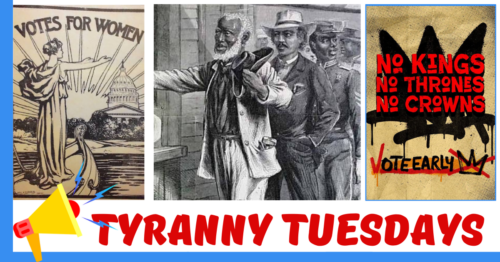
**📣 Tyranny Tuesday • October 20, 2026 • Indivisible Northern Nevada**
*✊ Famous Americans Who Would Not Take No-Vote For an Answer: They Fought for the Ballot. Now It’s Our Turn.
🤝Friends, in two weeks Americans go to the polls. Before we raise our signs, let’s remember the people who made that ballot possible. None of them were handed the vote. They were mocked, arrested, beaten, and jailed, and they kept going anyway.
💙Women’s Suffrage & the 19th Amendment
Susan B. Anthony co-founded the National Woman Suffrage Association in 1869 and spent decades crisscrossing the country for a suffrage amendment. She was arrested for voting in 1872 and refused to pay her fine. The “Anthony Amendment” became the 19th Amendment. Her final public words: “Failure is impossible.”
Elizabeth Cady Stanton co-organized the 1848 Seneca Falls Convention, America’s first women’s rights convention. She wrote its Declaration of Sentiments, which proclaimed that “all men and women are created equal.” Even her allies called her demand for the vote too radical, but it became the movement’s founding goal.
Alice Paul founded the National Woman’s Party and led the 1913 suffrage parade in Washington, where a mob attacked the marchers. Her “Silent Sentinels” picketed the White House and were jailed, beaten, and force-fed during hunger strikes. Public outrage over their treatment helped win the 19th Amendment in 1920.
Ida B. Wells-Barnett was born into slavery and became a fearless journalist. A mob destroyed her press over her reporting on lynching. In 1913 she refused to march at the back of the suffrage parade. That same year she founded Chicago’s Alpha Suffrage Club, which mobilized Black women voters to elect the city’s first Black alderman.
Mary Church Terrell was one of the first Black women to earn a college degree. She became the first president of the National Association of Colored Women, whose motto was “Lifting As We Climb,” and she was a charter member of the NAACP. She fought racism and sexism alike. In her late 80s, she led the fight that desegregated D.C. restaurants.
🤝The 15th Amendment
Frederick Douglass escaped slavery and became the nation’s most powerful abolitionist voice. At Seneca Falls he stood up for women’s suffrage, and after the Civil War he campaigned tirelessly for the 15th Amendment. It was ratified in 1870 and barred voting discrimination by race.
The Civil Rights Movement: The 1965 Voting Rights Act & the 24th Amendment
Dr. Martin Luther King, Jr. co-founded the Southern Christian Leadership Conference (SCLC) and helped lead the 1965 Selma-to-Montgomery marches. He endured bombings, arrests, and surveillance. Selma forced the nation’s hand, and the Voting Rights Act of 1965 was signed five months later.
🪧Fannie Lou Hamer was a Mississippi sharecropper who was fired and evicted for trying to register to vote, then brutally beaten in jail. She co-founded the Mississippi Freedom Democratic Party. Her 1964 convention testimony, “sick and tired of being sick and tired,” stunned the nation.
Ella Baker was the master organizer behind the NAACP, SCLC, and the 1960 founding of SNCC. She taught that “strong people don’t need strong leaders” and built the grassroots, community-led model that groups like ours still use.
Diane Nash led the Nashville sit-ins that desegregated lunch counters. When others wanted to stop the Freedom Rides after they were firebombed, she insisted they continue. She was jailed while pregnant, and she helped draft the voting-rights plan that became the Selma campaign.
John Lewis was a Freedom Rider and SNCC chairman. His skull was fractured on the Edmund Pettus Bridge on Bloody Sunday in 1965, and that sacrifice helped pass the Voting Rights Act. He served Georgia in Congress for more than 33 years and urged us all to make “good trouble.”
🏠The 26th Amendment: “Old Enough to Fight, Old Enough to Vote”
Sen. Jennings Randolph first proposed lowering the voting age to 18 in 1942. He kept at it for nearly 30 years until the amendment passed in 1971. It was ratified in about 100 days, the fastest in U.S. history.
President Dwight D. Eisenhower had sent 18-year-olds into combat in World War II. In 1954 he became the first president to call for giving them the vote.
Sen. Edward M. Kennedy pushed a law lowering the voting age in 1970. When the Supreme Court upheld it only partly, the result was a chaotic two-tier system, and Congress passed the 26th Amendment within months to fix it.
📣Our Charge
Every person you just heard about assembled, marched, petitioned, published, and spoke out. These are the 1st Amendment tools we use today. They used them to widen the circle of “We the People,” one amendment at a time. None of it came from the generosity of the powerful. It came from ordinary citizens who refused to be silent.
That is the tradition you are standing in today. Every sign you hold links Seneca Falls to the Pettus Bridge to this corner in Reno. You are using your 1st Amendment rights to expand equality and political representation, just as they did.
🪧Failure is impossible
🌟Make good trouble
💙And vote on November 3rd
✅ Your 2026 Voting Checklist
– 📝 Oct. 6 is the last day to register by mail or in person.** You can still register online through Election Day, or in person during early voting and on Election Day.
– 📬 Watch your mailbox.** Return your mail ballot early, or use a drop box by 7 p.m. on Election Day.
– 🗓️ Early voting:** October 17–30 *Election Day:** Tuesday, November 3
– 🔍 Check your registration** at [nvsos.gov](https://www.nvsos.gov) or [washoecounty.gov/voters](https://www.washoecounty.gov/voters/)
✊ JOIN US
📅 Date: October 20, 2026
🕙 Time: 10:00–11:00
📍 Location: Bruce R. Thompson Courthouse and Federal Building, 400 S. Virginia St., Reno, NV, 89501