We just concluded our Immigrant Justice Summer five-call national training series, preparing you for when ICE comes to your community. Missed a call? All the calls are available below ↓ to rewatch and will offer valuable skills for Indivisible groups and individuals.
Immigrant Justice Summer training series
Get the blueprint for mounting a safe, hyper-local, immigrant-aligned response when ICE comes to your community.

Call #1: Your Three Steps to Organizing for Immigrant Justice when ICE Comes to Your Community
When ICE surges in your community, do you know what to do? Join Indivisible for the first call in our Immigrant Justice Summer training series, where we’ll give you a concrete three-step blueprint for mounting a safe, hyper-local, immigrant-aligned response.

Call #2: Get Aligned — How to Connect with Immigrant-Led Organizations in Your Community
The strength of any response to ICE enforcement depends on the relationships that exist before a surge hits. This call trains you on community ecosystem mapping, a structured tool for identifying who is already organizing immigrant defense work in your community, what they are working on, and where the gaps are in your local organizing ecosystem.

Call #3: Show Up With a Plan — Roles and Rapid Response Strategies for Immigrant Justice
When an ICE surge hits and there is no clarity on what to do, responses stall and the window to act closes fast. This call trains you on the components of a rapid response: the coordinated set of actions your community takes in real time when ICE is active, and what it looks like to show up with a plan.

Call #4: Grow the Circle — How to Build a Link Tree to Channel Support to Immigrant Justice Organizing in Your Community
This call trains you on how to build a link tree that functions as your community’s entry point into the immigrant-led response, channeling new people, information, and training and mutual resources directly to where they’re needed on the ground.

Call #5: How to Use Signal for Immigrant Justice Rapid Response in Your Community
When ICE comes to your community, the window to coordinate is measured in minutes. A rapid response plan means nothing if your communication infrastructure isn’t already in place. This hands-on workshop trains you on how to use Signal to build the secure, layered communication structure your community needs to respond fast when it matters most.
What else can you do?
- Strengthen your local connections and neighborhood response systems. Join local mutual aid efforts, sign up for grocery deliveries, or find other ways to help your neighbors.
- Create space for grief, solidarity, and collective action.
- Join or start a local rapid response network, so that your community is prepared to mobilize quickly against a new detention facility, a new surge in militarized enforcement from the regime, or other threats posed to you and your neighbors.
- Paint murals, create art installations, host cookouts, and highlight joy in this fight to assert the dignity of our immigrant friends and family members.
- Support immigrant-led organizations working on the ground; follow their lead and where appropriate propose tangible ways you could help with their next initiative.
Bring Local Businesses To Our Side
Businesses have a role in this fight too. When local businesses publicly oppose ICE and commit to protecting their workers, it builds visible community opposition and emboldens others to take a stand. Courage is contagious, and you can be part of that magic.
- Ask local businesses and workplaces to become Fourth Amendment workplaces that keep your community safe from ICE. Check out this toolkit from Siembra NC to get started canvassing in your town.
- This resource is developed by Siembra NC and shared for informational purposes only and does not constitute official legal advice.
- Ask local businesses to publicly display signs opposing ICE warehouses. This helps build backlash against an existing or proposed detention center in your community and can embolden others to take a stand against these detention centers too. You can purchase signs through the Indivisible store or download and print signs here.
All actions taken under this campaign are nonviolent and lawful. A core principle of Indivisible and our partners is a commitment to nonviolent action. All participants are expected to seek to de-escalate any potential confrontation and to act lawfully at all events.
THE WONKY DETAILS
THE PROBLEM
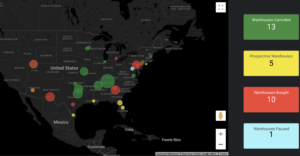
- The Trump administration is pursuing a mass detention expansion at a massive scale. ICE is currently detaining more than 70,000 people and has stated plans to expand to 100,000. To get there, Department of Homeland Security (DHS) has scouted or purchased approximately 23 warehouses nationwide, with individual facilities designed to hold between 1,500 and 10,000 people each. Trump’s MAGA allies in Congress funded this agenda with over $170 billion for DHS, including $45 billion specifically for detention expansion.
- These are not facilities designed for people. They are former industrial buildings, built for storing products, located in industrial zones. They lack the basic infrastructure required for human habitation: adequate water, sewer, ventilation, heating and cooling, and life-safety systems. They are purchased or fast-tracked in ways that bypass local land-use decisions and community input. Often they sit in working-class communities and communities of color already burdened by industrial activity.
- The harms to surrounding communities are real. Detention facilities increase surveillance and enforcement in the neighborhoods around them. They strain local infrastructure, including roads, water systems, and emergency services. They lock states and localities into long-term detention infrastructure they did not choose and cannot easily undo. And they tie local communities to an industry built on caging people.
- ICE’s existing detention system already has a well-documented history of neglect and abuse. In 2025 alone, 32 people died in ICE custody, the deadliest year the agency has seen in more than two decades. People died of seizures, heart failure, stroke, and respiratory failure. In case after case, families reported that their loved ones had asked for medical care and been ignored. And because these sites often sit in industrial zones far from population centers, accountability is harder to demand and harder to enforce.
OUR CORE DEMANDS
These are the demands we are organizing around. They apply to every community fighting a proposed or existing detention site.
- Cancel the warehouse detention plan and stop every conversion immediately.
- Local governments must abandon any plan to convert a warehouse into an immigration detention or processing facility. Warehouses are not appropriate for human confinement. Expanding detention through industrial spaces deepens harm to people and communities. Any such project must be canceled in full, with no detention use allowed at that site.
- Reject all public funding, permits, and local resources that enable detention expansion.
- Local governments must refuse to provide any funding, permits, services, or cooperation that would enable DHS or ICE to operate a detention facility. Public dollars and local infrastructure should not be used to cage people. These resources must instead go toward policies and services that support all members of our community.
- Require full transparency and real community consent before any federal detention action moves forward.
- Local officials must demand full public disclosure of all plans, contracts, and intended uses of any proposed detention site. They must commit to opposing any project that moves forward without meaningful community input. All required environmental review laws, including the National Environmental Policy Act, must be fully followed. Decisions about detention cannot be made behind closed doors.
Frequently Asked Questions
RESOURCES
- Watch the 4/14/26 National training call recording
- Read Detention Watch Network’s DHS Expansion of Immigration Detention into Warehouses: Toolkit for Local and State Interventions
- View Project Salt Box’s ICE Warehouse Tracker
- Access the Know Your Rights Resource Guide from the No Kings Coalition
- Get to know the Know Your Rights Resource Guide – en Español from the No Kings Coalition
- Read up on Indivisible’s Safety, Security, and Digital Preparedness for a Second Trump Administration Resource
- Review ACLU’s Know Your Rights Resource